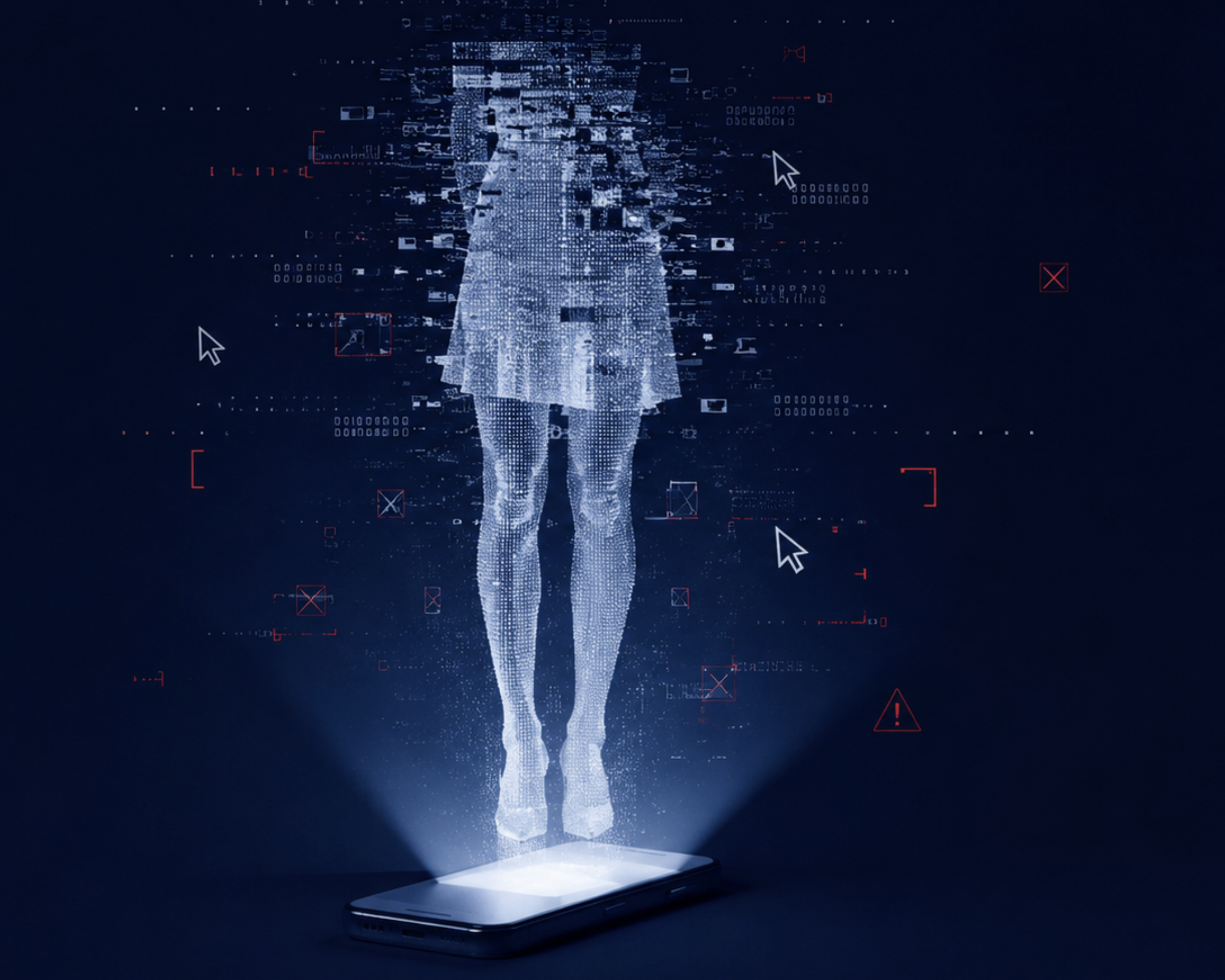
Generative AI can create a version of a woman that never existed, and make her bear the consequences anyway. The technology behind sexualized deepfakes may be new, but the assumption beneath them is painfully familiar: that a woman’s image is available for someone else to use.
There is something uniquely unsettling about being made to exist somewhere you have never been. A photograph begins with you. An AI-generated image does not have to. A woman can wake up to discover a version of herself circulating online that she never posed for, never created, and never consented to. Her face may be hers. The image may look convincing. But the moment depicted never happened. The image is fake. The humiliation, fear, reputational damage, and loss of control that can follow are not. This is one of the darker contradictions of generative artificial intelligence. We have built technology capable of turning a few words into images that once required teams of artists and hours of work. The same tools that allow extraordinary creativity can also make it dramatically easier to manipulate someone’s likeness. And the burden of that misuse is not distributed equally.
A 2024 United Nations report on violence against women and girls, citing research from Sensity AI, reported that an estimated 90 to 95 percent of online deepfakes were non-consensual pornographic images, and roughly 90 percent of those depicted women. Australia’s Safety Commissioner has cited another analysis estimating that pornographic material accounts for 98 percent of deepfake videos online and that women and girls constitute 99 percent of the people depicted in that material. Different studies use different datasets, but their conclusion is remarkably consistent: this form of AI-enabled abuse is overwhelmingly gendered. That should force us to ask a question larger than whether an image is technically authentic. What does consent mean when technology can manufacture the thing you never consented to?
The technology changed. The entitlement did not. AI did not invent the objectification of women. Women’s bodies and appearances were being scrutinized, edited, commercialized and circulated long before anyone could type a sentence into an image generator. What generative AI changes is the amount of skill, time, and access required to fabricate something believable. The underlying assumption, however, can be much older: I can see you, therefore I can use you. A photograph posted publicly is especially vulnerable to this distortion of consent. We have become accustomed to thinking that once something appears online, it has somehow entered a communal pile of digital material: something to screenshot, repost, edit, meme, remix or feed into another program. But visibility is not permission. A woman choosing to publish a photograph of herself has consented to the photograph she published. She has not consented to every possible transformation another person can make from it. That distinction sounds obvious when written plainly. Our technology has made it frighteningly easy to ignore. UNESCO now describes AI-enabled deepfakes and non-consensual image generation as forms of technology-facilitated gender-based violence, warning that women and girls are disproportionately affected. Its recent work on ethical AI argues that generative systems can do more than reproduce existing gender inequalities: without adequate safeguards, they can amplify them.
A fake image can create real consequences. There is a tempting response to synthetic imagery: But everyone knows it could be fake. That misses the point. The harm does not depend entirely on whether every viewer believes an image is authentic. Something fabricated can still be copied, circulated, attached to someone's name, used to humiliate them, or remain searchable long after its origin has been forgotten. And increasingly, women are being asked to prove that something didn't happen. That represents a strange reversal of the promise of artificial intelligence. Technology was supposed to help us create new things. Instead, in these cases, the person targeted is left trying to separate herself from something another person created in her name. UN Women warns that technology-facilitated abuse can have consequences far beyond the screen, affecting women's mental well-being, relationships, careers, safety, and willingness to participate publicly online. It also identifies women who are highly visible online—including journalists, activists, politicians, and young women—as particularly exposed to digital violence. There is therefore another cost that is harder to count. Silence. What happens when women begin calculating whether posting a photograph, expressing an opinion, becoming visible online, or entering public life makes them easier to target? Technology does not need to physically remove a woman from a public space to narrow that space around her. Sometimes making participation feel dangerous is enough.
For years, technology moved faster than the language many legal systems had for describing this kind of abuse. That is beginning to change. In the United States, the TAKE IT DOWN Act became federal law on May 19, 2025. The law addresses non-consensual intimate imagery, including certain computer-generated “digital forgeries.” It also requires covered online platforms to provide a process through which people can request removal of qualifying images. Beginning in May 2026, covered platforms were required to have that process operating and, after receiving a valid request, generally remove qualifying material and known identical copies, within 48 hours. The Federal Trade Commission is responsible for enforcing platform compliance. Legislation matters. But law alone cannot answer the larger cultural question AI has exposed. Just because we can create something, why do we assume we are entitled to? Consent has to survive innovation. The conversation around artificial intelligence is often framed around what comes next. What jobs will change? What will machines become capable of? How realistic will generated images become? How will we distinguish authentic media from synthetic media? Those are important questions. But perhaps there is another one we should be asking alongside them: What parts of human dignity should not have to be renegotiated every time technology advances? Consent should be one of them. A newer machine does not create a newer definition of ownership over another person. A better image generator does not weaken someone's claim to her own likeness. And technological innovation should not require women to surrender control over themselves simply because the tools capable of violating that control have become more sophisticated. The future will contain images that are increasingly difficult to distinguish from reality. That makes technological safeguards, platform accountability, effective laws, and public literacy essential. But it also requires something far less technical. Restraint. The recognition that another person is not raw material. That a face found online still belongs to someone. That possibility is not permission. And that behind every synthetic version of a woman is a real woman who may be forced to live with something she never made. AI can manufacture an image. It cannot manufacture her consent.
References United Nations. (2024). Intensification of efforts to eliminate all forms of violence against women and girls: Report of the Secretary-General. The report discusses generative AI, image-based abuse, and evidence on the disproportionate targeting of women through deepfakes. UN Women. (2025). Online safety 101: What every woman and girl should know. UN Women discusses image-based abuse, AI-generated deepfakes, and the effects of digital violence on women and girls. UNESCO. (2025). Tackling Gender Bias and Harms in Artificial Intelligence (AI). UNESCO examines gender bias and technology-facilitated gender-based violence connected to generative AI. UNESCO. (2026). UNESCO Launches Report to Tackle AI-Enabled Gender-Based Violence. The report addresses deepfakes, non-consensual image generation, digital stalking, and other AI-enabled harms disproportionately affecting women and girls. Australian eSafety Commissioner. (2024). Addressing deepfake image-based abuse. The Commissioner summarizes evidence on the gendered prevalence of deepfake abuse. U.S. Congress. (2025). TAKE IT DOWN Act, Pub. L. No. 119-12. The law covers certain non-consensual intimate depictions, including digital forgeries produced through AI and other technologies. Federal Trade Commission. (2026). FTC Enforces Compliance With the Take It Down Act. The FTC explains the removal requirements that took effect in May 2026.